 Spoken Once
Talking Shouldn’t Feel Like a Project
Sometimes the best stories come when nobody is trying too hard to tell one.
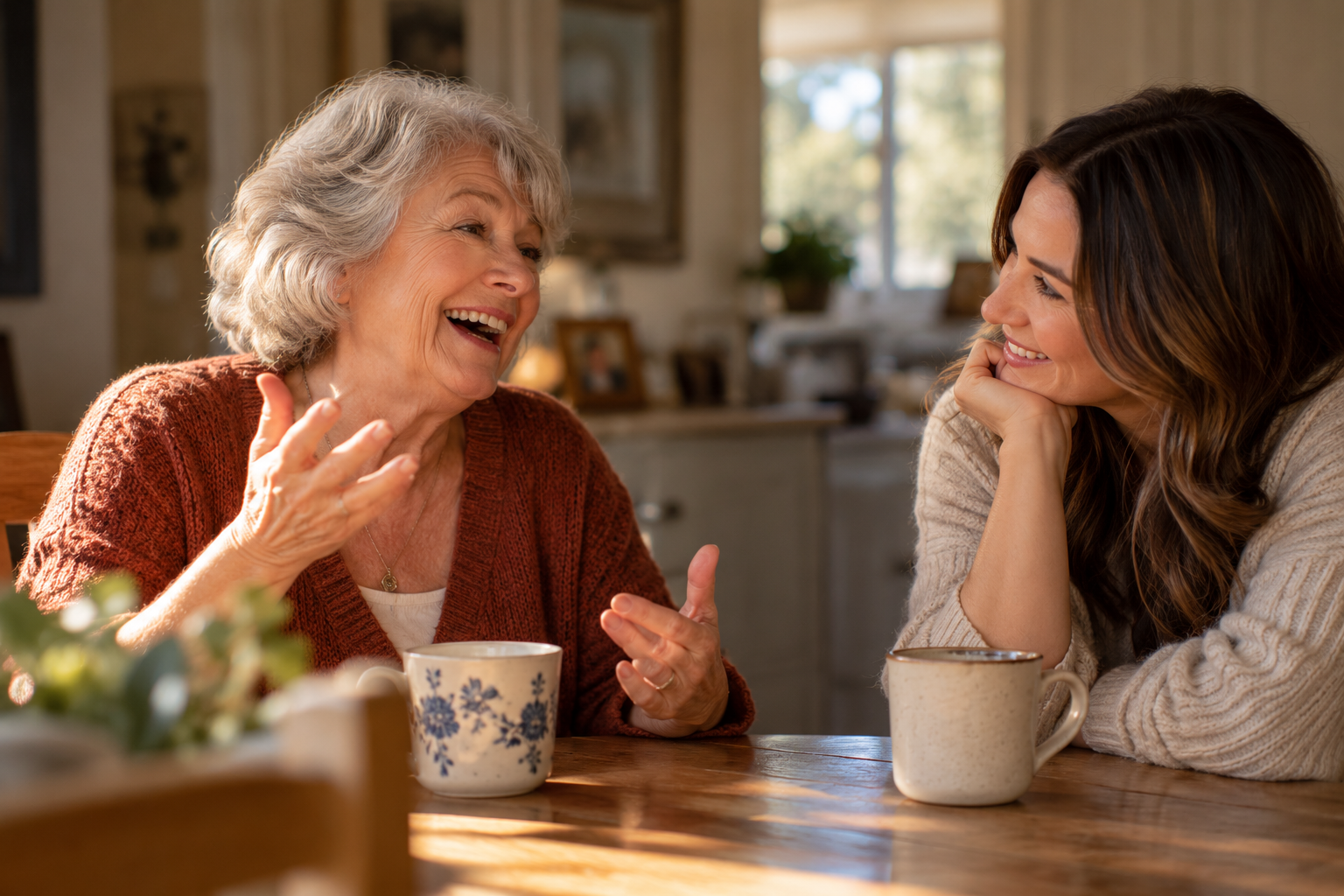
Talking Shouldn’t Feel Like a Project
Start a conversation and let the rest happen naturally.
My mom is getting older, and one day a thought popped into my head that terrified me.
What if I forget her voice someday?
Not the things she said.
Her actual voice.
Which is funny, because there are times when my mom is talking to me at a hundred words a minute and I feel like I’m being attacked by a mosquito in my ear.
But I know something else, too.
Someday, those are the exact crazy anecdotes I’m going to miss hearing from her.
Not just the important things.
Not some perfectly organized account of her life.
Her.
The way she talks. The things she gets distracted by. The stories that lead to other stories. The little expressions I’ve heard a thousand times and barely notice anymore.
So naturally, I wanted to record her.
And that’s when I ran into a problem.
I didn’t want to turn my mom into a project
There are a lot of ways to preserve someone’s story.
You can make a list of questions. Start with childhood. Move through school, marriage, work, children, grandchildren. Ask about the important moments. Collect the photographs. Fill in the dates.
There’s absolutely nothing wrong with that.
In fact, for some people, I imagine it’s wonderful.
My mom would last about seven minutes.
Maybe four.
The more I thought about sitting her down and asking her to work her way through a long list of questions about her life, the more I realized I was designing an experience for the story I wanted to collect instead of the person I wanted to hear.
Those are two very different things.
My mom isn’t a sit-down-and-answer-47-questions kind of woman.
And if I somehow convinced her to do it, I’m not sure the result would even sound like her.
What felt right was much simpler.
Sit with me for a little while.
Tell me a story you love.
That’s it.
Comfortable people tell better stories
Maybe “better” isn’t even the right word.
They tell stories that sound more like themselves.
When we’re comfortable, we stop worrying so much about giving the right answer.
We wander.
We remember something halfway through one story that takes us into another.
We laugh before we get to the funny part.
We forget somebody’s name, remember it three minutes later, and interrupt ourselves to announce that we finally remembered it.
That isn’t bad storytelling.
That’s a person telling a story.
And those little detours can tell us as much about someone as the story itself.
I don’t want my mom to sound like she’s giving testimony for the historical record.
I want her to sound like my mom.
You don’t have to start at the beginning
“Tell me your life story” is an enormous question.
Where do you start?
Birth?
Kindergarten?
The first job?
And suddenly something that was supposed to be meaningful feels suspiciously like homework.
So maybe we’ve been making this harder than it needs to be.
You don’t have to capture an entire life in chronological order.
You can start with one story.
Tell me about the day you met Dad.
What was Grandma actually like?
What happened on that vacation everybody still talks about?
How did you end up choosing that career?
Why did Uncle Bob refuse to speak to the neighbor for six years?
Now we’re talking.
And something interesting happens when people start talking.
Stories have a way of finding other stories.
One person reminds us of another. One place brings back another time. Something funny leads to something serious. A detail that seemed completely unimportant turns out to be the part everyone remembers.
You don’t have to force any of it.
You just have to give the conversation somewhere to begin.
A life isn’t a checklist
I understand the temptation to make a list.
When something matters to us, we’re afraid of missing something.
Did we ask about childhood?
Did we get the story about Grandpa?
What about the first house?
Did we talk about the kids?
But I’m beginning to think preserving someone isn’t about successfully checking every box.
There will always be another question we could have asked.
Another story we didn’t hear.
Another photograph whose story nobody quite remembers.
Maybe the goal doesn’t have to be completeness.
Maybe the goal is simply to keep something real.
One story.
One laugh.
One afternoon when someone you love sat down and talked like they always talk.
There can be an incredible amount of a person inside that.
The way we preserve someone should feel like them
Some people love questions.
Some people want to sit down for three hours and tell you everything from 1957 onward.
Wonderful.
Let them.
Other people need a story to sneak up on them.
They need somebody to say, “Wait. Tell me that one again.”
And suddenly they’re off.
Neither way is better.
What matters is that the person feels comfortable enough to stop thinking about the recording and start thinking about the story.
That was the realization for me.
I didn’t need my mom to become a different kind of storyteller just because I wanted to preserve her stories.
I needed to make room for her to be the storyteller she already is.
Because someday, I don’t think I’m going to wish I’d asked her 100 more questions.
I think I’m going to want to hear her.
Talking too fast.
Getting distracted.
Laughing at her own story.
Going off on some completely unnecessary tangent that somehow becomes the best part.
Maybe even making me feel like I’m being attacked by a mosquito in my ear.
And I have a feeling I’d give just about anything to hear her voice one more time.
Hear what happens when someone just talks.
Listen to Carol tell her story in her own voice.
Listen to Carol’s Keepsake